Teach-Now Module 5 Unit 2 Activity 1
Assessing Project Based Learning
William Ross
Grade 10
World History
The Revolution Project
Overview
This project works in tandem with a unit on historic revolutions, their causes and outcomes, and lasting effects. Throughout the project, students will work on group projects in which they become familiar with famous revolutions, analyze their effectiveness, and present arguments either against or in defense of a revolution and its ramifications. Students are assessed via multiple forms of formative assessment and a formal formative assessment, all of which build to an end of unit summative assessment based on the educational standards for the course.
Description
An Effective Revolution
Driving Question: What are the elements of an effective revolution?
Students are placed into groups of six. Groups are assigned countries, all of which have significant socioeconomic disparity and inequality among the population. Each student is assigned a role. Each role represents different social classes, professions, and privileges. Students are given primary and secondary resources to help solidify their understanding.
Identifying as their role, each student builds and presents to their group an argument describing the changes that they believe would be necessary for a just and democratic society. These changes can be in the form of taxation, legislation, strike, and revolution (among others). Each student provides sources for their argument.
Goal: Students will learn about the conditions, beliefs, and triggers of historic revolutions.
Each group then collaborates to build a coherent synopsis of their country’s current socioeconomic reality and the steps that they deem necessary to change it into a society that is fair and functional. Students identify the owners of roles, including speaker, researcher, and writer, and begin to work on their overall argument. While the project is developing, students are given the opportunity to meet with individuals from other groups that share similar roles to get their feedback and advice on ways to better formulate their positions. The project culminates in group presentations where they deliver their oral arguments, along with historic context, to the class.
Formative Assessments
Exit Ticket:
What do you believe is the most important aspect of a fair and just society?
Analysis: Exit tickets are collected by the teacher and analyzed to ensure that students are becoming familiar with the fundamentals of revolutions and their purposes.
Quote:
Students are given a quote from a famous historic revolutionary and asked the following questions:
What does this quote mean to you?
What does this quote tell you about the author’s opinions on revolutions and their leaders?
Based on what you know about revolutions, do you agree with this quote?
Students are given time to formulate their responses which are then collected by the teacher and analyzed to ensure students are developing a well-rounded understanding of historic revolutions, their triggers, and their leaders.
Project Assessment
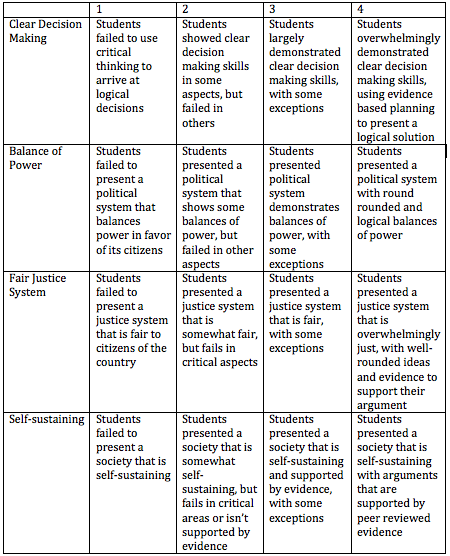
Each group is assessed by the teacher and other groups based on the following criteria (each a 1-4 scale, 1 being the weakest point value)

 William Ross TeachNow Blog